
Emotional Support Spreadsheets
draft to debut in an embarrassing number of spreadsheets
Look, I really like gathering and organizing and thinking about data. I am not, generally, a detail-oriented person, but I take great joy and comfort from a well-sorted, complete spreadsheet. A bulwark of information against the vast, messy, “it depends” of life in general, and publishing in particular.
So this month’s zine is a tour of the spreadsheets that carried me from drafting, all the way to my novel’s debut.
Drafting & Revision
I’ve written before about where I fall on the plotter-pantser-secret-third-thing scale: as a secret-third-thing writer, spreadsheets don’t really enter into my Process until after the first (several) messy draft(s) are complete. For Homebound, I made various sentence-outline spreadsheets, color coded by the character/storyline. I added word counts and squinted at where, percentage-wise, they fell in the overall arc of the book. I moved things around. I printed the spreadsheets and made notes. I added tabs, to iterate different orders.
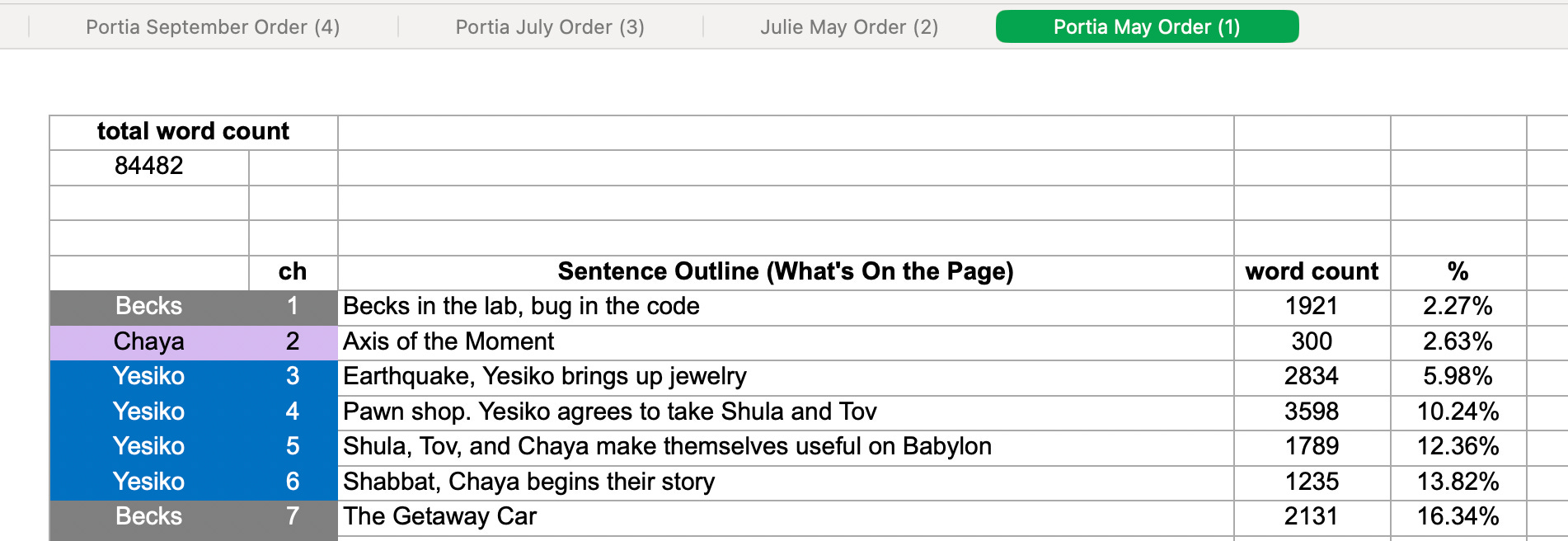
The spreadsheet turned the vast, soft body of the whole book into discrete parts with edges I could touch and hold. I couldn’t have created it or even imagined it before the book existed in some kind of draft form — but once it did, the spreadsheet became a map, a mirror, a microscope.
Querying: Agent Dreams
Querying agents, in search of representation, is often described as being “in the trenches.” It’s not a process where writers feel a great deal of agency or control — we’re sending out short letters, describing the 70-100k-word things we’ve made, saying “Maybe you want to sell this for us? Please?”
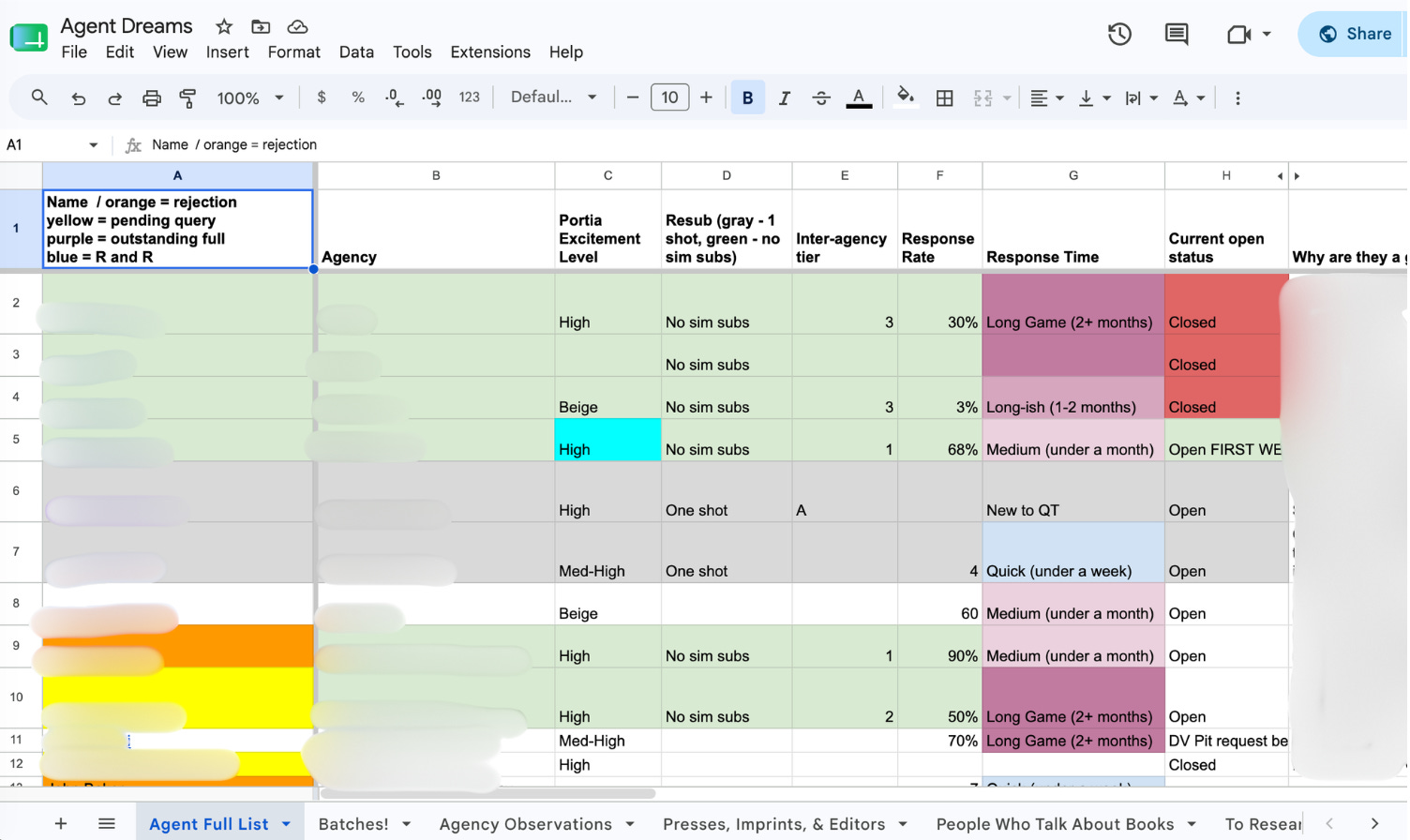
So I kept a slightly unhinged spreadsheet of the agents I was querying — even though there’s a truly excellent website (QueryTracker) that collects basically all this same data.
What Comes Next
Ahhh, welcome to the era of the What Comes Next spreadsheet, where I chronicled all that came after signing with my agent!
The first What Comes Next is deceptively numbered “2”, for reasons I can’t remember. It’s the spreadsheet I kept while I was on submission to publishers, with a tab for the editors my agent sent the book to, and various brainstorms that I somehow thought would be relevant and helpful down the line. This is around the time I started reading Jeffrey Yamaguchi’s excellent Substack “Book Publishing Brick by Brick”.
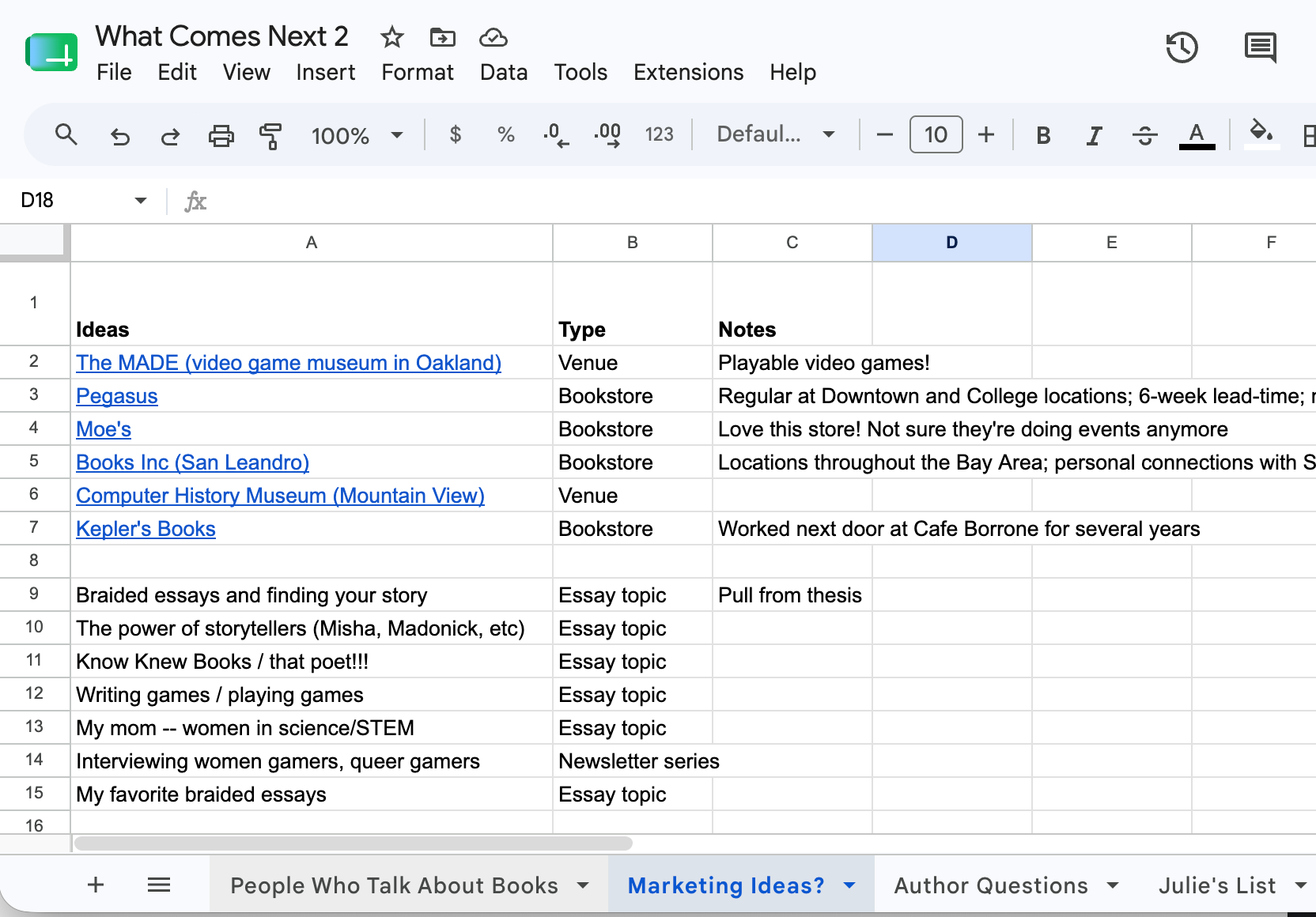
This was really — really — just a way of staying sane, because I wasn’t ready to start writing something new, but there was also nothing I could do for Homebound. It was all in the hands of my agent/the editors.
And then the book sold! And we graduated to What Comes Next 3!
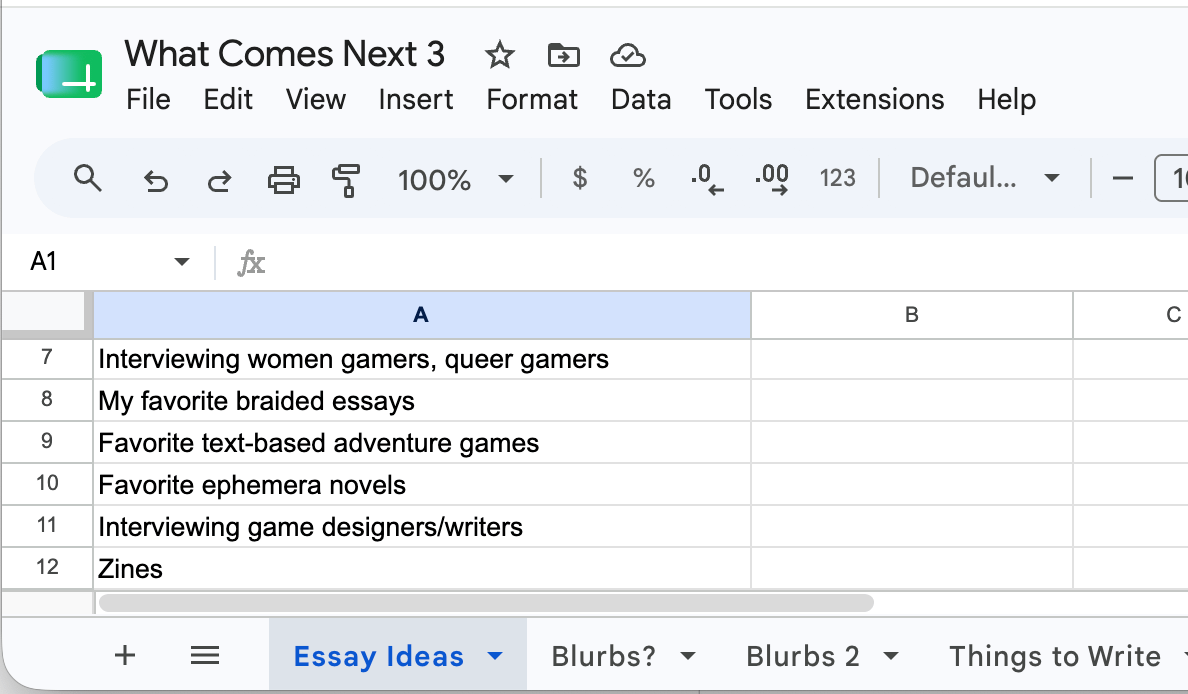
Honestly, this was also a lot of “keeping myself busy.” The “Blurbs?” and “Blurbs 2” tabs did have all the drafts of personalized notes I sent with our blurb requests, but otherwise this was just somewhere I could feel like I was doing something. Sometimes that’s what a spreadsheet is great for.
And then we were off to to the final spreadsheet in this era, What Comes Next 4! This spreadsheet carried me almost all the way to publication…
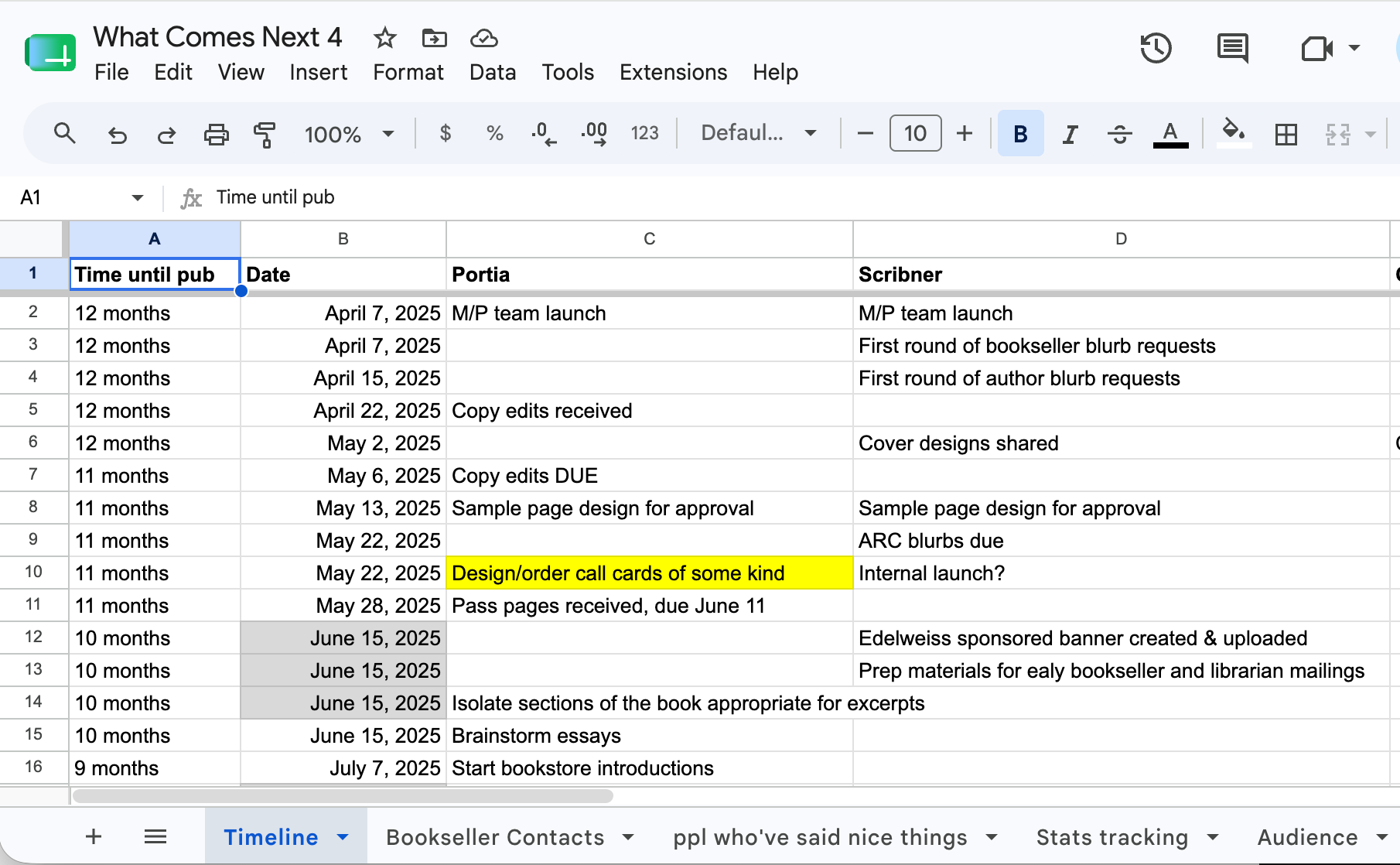
My publication team kept me really in the loop, for which I was so grateful. I also started tracking all the booksellers I talked to, which would later become a part of a bigger list of everyone I had talked to…
Side Quests
I made three side quest spreadsheets in the lead up to publication, all of which you can actually look at! They’re linked below.
Brand, UGH?
This was my attempt to reconcile my deeply ambivalent feelings about the idea of an “author brand”. I sorted elements of the publication process (professional associations, blurbs, awards, website, social media, etc) by degree of control (100% in my control —> low-to-no control). I thought about how I want to make readers, fellow writers, and my publishing team feel when they read my writing or interact with me.
Did this solve my discomfort with social media?
No, unfortunately. But it make me feel like, maybe, I have a compass with which to navigate the Charybdis of Instagram.
Bay Area Bookstores
Oh, this was a fun spreadsheet to make! It is, to the best of my abilities, a full list of (new) bookstores within a 2 hour drive of where I live. Current count is 96 (that doesn’t include used bookstores!) — I truly live in an abundance of bookstores!!
DIY Media Training
Writing a book: one skill set
Talking about your book? Totally different skill set!
I pulled together all of the podcasts, articles, Reddit threads, webinars, etc that I could find about learning how to connect with potential readers. I looked for best practices, commonly asked questions, etc. I did end up hiring a media coach closer to publication (so helpful!) and I think that working through some of these resources with a friend would have been really helpful, too.
Numbers?
One of my great joys, when I worked at the library, was tracking circulation stats. It felt like gamification — the delight of seeing circ stats increase and being able to point to changes or strategies that helped drive that increase.
So of course I started tracking the first kind of stat I had access to: Goodreads “want to reads”.
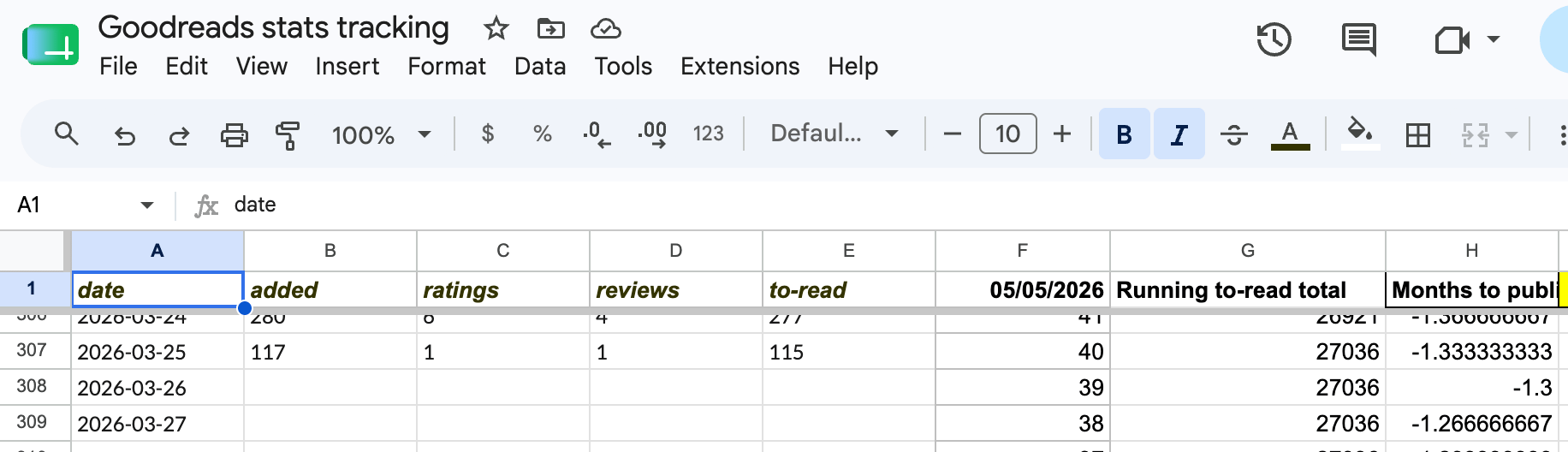
The problem was, even if I was avoiding reading the reviews, the dashboard where I could see the “want to reads” also told me if there was a new review. And I couldn’t help clicking through to see it…
I kept hurting my own feelings! As you can see, I stopped updating this (and blocked the Goodreads dashboard) a couple of months before publication, so this spreadsheet and graph remain incomplete.
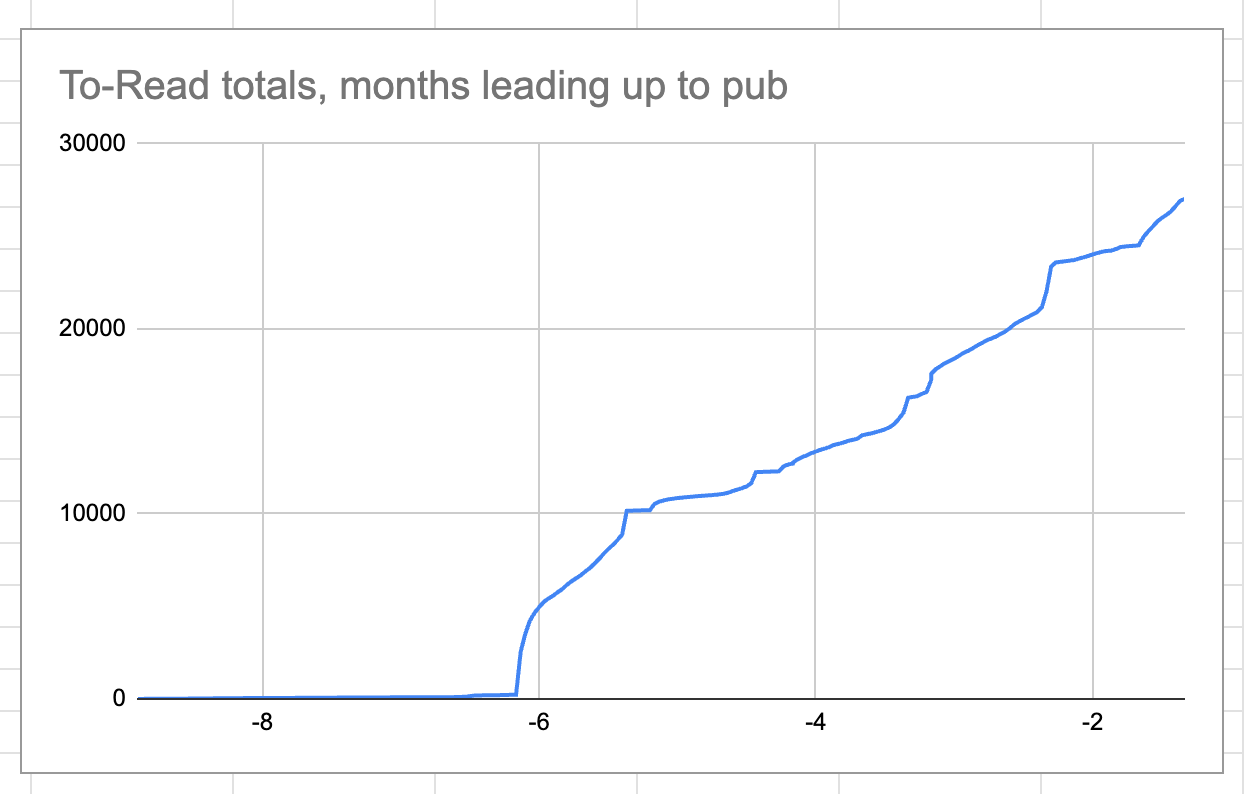
I’m also tracking what sales data I have access to, but for now that spreadsheet feels wildly private — I feel happy about the numbers I see, without any context or understanding other than that I can see people are buying my book. I don’t really want to pop that bubble!
Talk Talk Talk
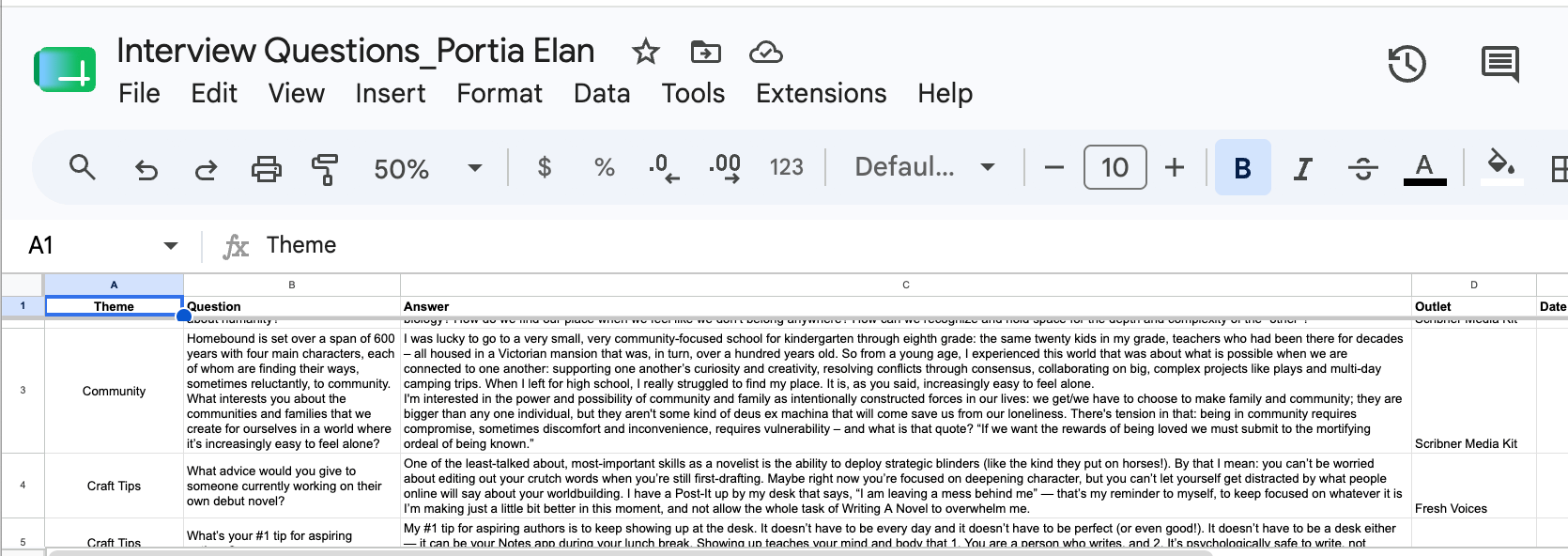
Right now, I’ve got two more active spreadsheets. One is a collection of all my written interview responses, organized by theme:
The other is a multi-tabbed collection of everyone who has talked about Homebound: articles and reviews, blurbs, trade reviews, Instagram tags (this one isn’t up to date, RIP), and people (Contacts).
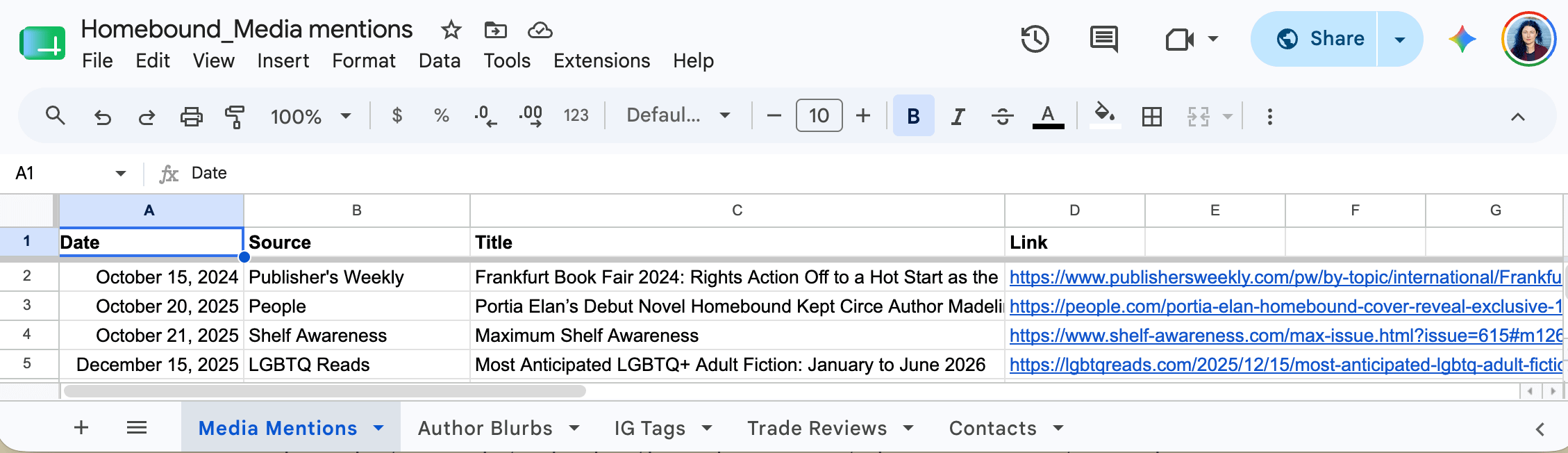
There are a lot of book things that arrive via email (trade reviews, blurbs), and things that float through the internet (lists, mentions) and I needed a way to corral it all. Plus, it feels concrete, like evidence for those moments when I wondered if anyone would even pick up my book.
The “Contacts” tab lists literally everyone I’ve talked to on the road to publication — booksellers, librarians, podcast hosts, fellow writers on panels or at conferences.
A great deal of being human feels ephemeral, squishy, and tentative.
Will they hold weight, these ideas I’ve built?
Have these hours of labor yielded anything but exhaustion?
What can I know about the unknown of tomorrow, and the next day, and the next?
A spreadsheet becomes a place to put things — hopes and uncertainties alike — a way to look at them and find connections and meaning. (Also sometimes a way to stay busy, to feel purposeful, when no other purpose can be found.)
Thus ends my ode to the spreadsheet!
If you made it all the way through: may your spreadsheets be “reference error” free, may your dates copy correctly, may your charts appear just as you envision them!
Love,
portia